
 ,
Ayomadewa Mercy Olatunya,
Mayowa Akeem Azeez,
Edward Olorunsola Olanipekun,
Funmilayo Deborah Adewumi,
Teni Patricia Fagbemiro
,
Ayomadewa Mercy Olatunya,
Mayowa Akeem Azeez,
Edward Olorunsola Olanipekun,
Funmilayo Deborah Adewumi,
Teni Patricia Fagbemiro
Fruit juice is one of the highly consumed packaged drinks in Nigeria. As a result of the large consumption and to know the levels of organic acids in them, three (3) fruit juices were selected. The analysis of organic acids in the three fruit juice samples sold within Nigeria was carried out using High Performance Liquid Chromatography (HPLC- Agilent 1260 infinity). A reversed-phase separation using a C-18 column was employed, followed by the organic acids quantification. An isocratic elution method using a buffered mobile phase of KH2PO4 adequately aided the separation. The organic acids detected comprised oxalic acid, tartaric acid, fumaric acid, ascorbic acid, citric acid, and succinic acid. The results revealed that levels of citric acid in the three samples ranged from 0.23 to 1.07 mg/mL, the levels of ascorbic acid ranged from 0.0016 to 0.203 mg/mL, and the values of oxalic acid ranged from 0.24 to 4.41 mg/mL. As revealed in the results, the organic acids of interest were available in the fruits juices. However, Sample A was the only orange juice that showed a significant amount of tartaric acid recording 0.5 mg/mL. The method demonstrated good linearity, precision, and accuracy making it suitable for routine analysis of juice samples.
| Published in | Chemical and Biomolecular Engineering (Volume 11, Issue 1) |
| DOI | 10.11648/j.cbe.20261101.11 |
| Page(s) | 1-7 |
| Creative Commons |
This is an Open Access article, distributed under the terms of the Creative Commons Attribution 4.0 International License (http://creativecommons.org/licenses/by/4.0/), which permits unrestricted use, distribution and reproduction in any medium or format, provided the original work is properly cited. |
| Copyright |
Copyright © The Author(s), 2026. Published by Science Publishing Group |
HPLC, Organic Acids, Orange Juice, Food Quality, Nigeria, Citric Acid, Oxalic Acid
Parameter | Description |
|---|---|
Column | Agilent 1260 infinity C18, 3.5Μm, 3.5 × 100 mm |
Mobile phase | Isocratic, 25 mM K-phosphate buffer, pH 2.4 |
Analysis Time | 15 min |
Flow rate | 0.3 mL/min (57 bar) |
Oven Temperature | 20°C |
VW Detection | Wavelength: 210 nm |
Organic acids | Oxalic | Tartaric | Ascorbic | Citric | Succinic | Fumaric |
|---|---|---|---|---|---|---|
Concentration | 0.142 | 0.546 | 0.162 | 0.965 | 0.609 | 0.021 |
Level | 1 | 2 | 3 | 4 | 5 |
|---|---|---|---|---|---|
Stock Standard Solution | 0.16 | 0.32 | 0.64 | 1.28 | 2.56 |
Organic Acid | Sample A | Sample B | Sample C |
|---|---|---|---|
Oxalic | 0.24 | 1.63 | 4.41 |
Tartaric | 0.50 | ND | ND |
Fumaric | ND | ND | ND |
Ascorbic | 0.203 | 0.0060 | 0.0016 |
Citric | 1.07 | 0.49 | 0.23 |
Succinic | ND | ND | ND |
HPLC | High Performance Liquid Chromatography |
ND | Not Detected |
WHO | World Health Organization |
| [1] | Nicklas T. A., O’Neil, C., Fulgoni, V. (2015). Replacing 100% Fruit Juice with Whole Fruit Results in a Trade Off of Nutrients in the Diets of Children. Current Nutrition and Food Science, 11(4), 267-273. |
| [2] | Luger, M., Lafontan, M., Bes-Rastrollo, M., Winzer, E., Yumuk, V., & Farpour-Lambert, N. (2017). Sugarsweetened beverages and weight gain in children and adults: A systematic review from 2013 to 2015 and a comparison with previous studies. Obesity Facts, 10(6), 674-693. |
| [3] |
World Health Organization (WHO). (2021). Obesity and Overweight. Fact Sheet. Geneva.
https://www.who.int/en/news-room/factsheets/detail/obesity-and-overweight |
| [4] | Akhtar, M. S., Siddiqui, S. (2014). Organic Acids: A Review on Current Status and Challenges. Journal of Applied Sciences, 14(5), 519-527. |
| [5] | Valasco, L., Perez-Navarro, J. C., Palacios, V., Ocana-Gonzalez, J. A. (2020). Organic acid composition in grape juices and wines from Spanish cultivars. Molecules, 25(9), 2191-2192. |
| [6] | Burgos, N., Perez-Lopez, E., Carmona-Alferez, R., Ortuno, A., & Lopez-Martinez, M. C (2019). The organic acid composition of citrus fruit juices is determined by capillary electrophoresis. Food Control, 98, 83-89. |
| [7] | Jaffar, S. I., Abdullah, M. A., Lim, K. K., Ibrahim, M. N., Sahbudin, S. (2021). Chemical composition and antioxidant activity of different fruit juices. Foods, 10(3), 598-600. |
| [8] | Okondu, O. E., Maitanmi, J. O., Akinola, M., Akingbade, O., Abubakar, K., Faleti, D. D., Chigeru, C., Oladimeji, T. D., Alao, E., Umahi, E., & Maitanmi, B. (2021). Dietary knowledge and practices among non-medical staff at Babcock University in Ogun state, Nigeria. Babcock University Medical Journal (BUMJ), 4(2), 112-119. |
| [9] | Olukayode, O. I., Oladeji, O. E., Oladosu, G. S., & Bolajoko, O. O. (2023). Food and Beverage Consumption Among Adolescents in Alimosho Local Government, Lagos State. Egyptian Journal of Nutrition, 38(3), 67-79. |
| [10] | Bolajoko, O., Lano-Maduagu A., Nupo S., & Oguntona B. (2022). Water and Beverage Intake among Civil Servants in Southwest Nigeria. Nigerian Journal of Nutritional Sciences, 43 (1), 22-27. |
| [11] | Nour, V., Trandafir, I., Ionica, M. E. (2010). HPLC organic acid analysis in different citrus juices under reversed phase conditions. Botanical Notes of the Agrobotanical Garden of Cluj-Napoca, 38(1), 44-48. |
| [12] | Higgins, J. P., Jogimahanti, A. V. (2023). Infectious agents and toxins and their route into the food chain, specific food groups and their distribution, soft drinks, fruit juices, and energy drinks. Reference Module in Food Science, 150-158. |
| [13] | Ul Hasan, M., Singh, Z., Shah, H. M. S., Kaur, J., Woodward, A., Afrifa-Yamoah, E., Malik, A. U. (2023). Oxalic acid: A blooming organic acid for postharvest quality preservation of fresh fruit and vegetables. Postharvest Biology and Technology, 206, 112-574. |
| [14] | Gurtler, J. B. Mai, T. L. (2014). Preservatives- traditional preservatives - organic acids. Encyclopedia of Food Microbiology, 4 119-130. |
| [15] | Karadeniz, F. (2004). Main organic acid distribution of authentic citrus juices in Turkey. Turkish Journal of Agriculture and Forestry, 28(4), 267-271. |
| [16] | Ren, Y. F., Amin, A., Malmstrom, H. (2009). Effects of tooth whitening and orange juice on surface properties of dental enamel. Journal of Dentistry, 37, 424-431. |
| [17] | Weikle, K. (2012). Determination of citric acid in fruit juices using HPLC. Concordia College Journal of Analytical Chemistry, 3, 57-62. |
| [18] | Duarte, A., Caixeirinho, D., Sustelo, V., Fernandes, M. M. (2012). Organic acids concentration in citrus juice from conventional versus organic farming. International Society for Horticultural Science (ISHS) 933, 601-606. |
| [19] | Zhang, M., Xu, R., Sun, G., Cheng, Y. (2022). The effect of short-term temperature pretreatment on sugars, organic acids, and amino acid metabolism in Valencia orange fruit. Journal of Food Quality, 1-9. |
| [20] | Gil-Izquierdo, A., Gil, M. I., Ferreres, F. (2002). Effect of processing techniques at industrial scale on orange juice antioxidant and beneficial health compounds. Journal of Agricultural and Food Chemistry, 50(18), 5107-5114. |
APA Style
Ayodele, O., Akinsola, A. F., Olatunya, A. M., Azeez, M. A., Olanipekun, E. O., et al. (2026). Analysis of Organic Acids in Three Commercial Fruit Juice Samples Sold Across Nigeria. Chemical and Biomolecular Engineering, 11(1), 1-7. https://doi.org/10.11648/j.cbe.20261101.11
ACS Style
Ayodele, O.; Akinsola, A. F.; Olatunya, A. M.; Azeez, M. A.; Olanipekun, E. O., et al. Analysis of Organic Acids in Three Commercial Fruit Juice Samples Sold Across Nigeria. Chem. Biomol. Eng. 2026, 11(1), 1-7. doi: 10.11648/j.cbe.20261101.11
@article{10.11648/j.cbe.20261101.11,
  author = {Olajide Ayodele and Abiodun Folasade Akinsola and Ayomadewa Mercy Olatunya and Mayowa Akeem Azeez and Edward Olorunsola Olanipekun and Funmilayo Deborah Adewumi and Teni Patricia Fagbemiro},
  title = {Analysis of Organic Acids in Three Commercial Fruit Juice Samples Sold Across Nigeria},
  journal = {Chemical and Biomolecular Engineering},
  volume = {11},
  number = {1},
  pages = {1-7},
  doi = {10.11648/j.cbe.20261101.11},
  url = {https://doi.org/10.11648/j.cbe.20261101.11},
  eprint = {https://article.sciencepublishinggroup.com/pdf/10.11648.j.cbe.20261101.11},
  abstract = {Fruit juice is one of the highly consumed packaged drinks in Nigeria. As a result of the large consumption and to know the levels of organic acids in them, three (3) fruit juices were selected. The analysis of organic acids in the three fruit juice samples sold within Nigeria was carried out using High Performance Liquid Chromatography (HPLC- Agilent 1260 infinity). A reversed-phase separation using a C-18 column was employed, followed by the organic acids quantification. An isocratic elution method using a buffered mobile phase of KH2PO4 adequately aided the separation. The organic acids detected comprised oxalic acid, tartaric acid, fumaric acid, ascorbic acid, citric acid, and succinic acid. The results revealed that levels of citric acid in the three samples ranged from 0.23 to 1.07 mg/mL, the levels of ascorbic acid ranged from 0.0016 to 0.203 mg/mL, and the values of oxalic acid ranged from 0.24 to 4.41 mg/mL. As revealed in the results, the organic acids of interest were available in the fruits juices. However, Sample A was the only orange juice that showed a significant amount of tartaric acid recording 0.5 mg/mL. The method demonstrated good linearity, precision, and accuracy making it suitable for routine analysis of juice samples.},
 year = {2026}
}
TY  - JOUR
T1  - Analysis of Organic Acids in Three Commercial Fruit Juice Samples Sold Across Nigeria
AU  - Olajide Ayodele
AU  - Abiodun Folasade Akinsola
AU  - Ayomadewa Mercy Olatunya
AU  - Mayowa Akeem Azeez
AU  - Edward Olorunsola Olanipekun
AU  - Funmilayo Deborah Adewumi
AU  - Teni Patricia Fagbemiro
Y1  - 2026/04/13
PY  - 2026
N1  - https://doi.org/10.11648/j.cbe.20261101.11
DO  - 10.11648/j.cbe.20261101.11
T2  - Chemical and Biomolecular Engineering
JF  - Chemical and Biomolecular Engineering
JO  - Chemical and Biomolecular Engineering
SP  - 1
EP  - 7
PB  - Science Publishing Group
SN  - 2578-8884
UR  - https://doi.org/10.11648/j.cbe.20261101.11
AB  - Fruit juice is one of the highly consumed packaged drinks in Nigeria. As a result of the large consumption and to know the levels of organic acids in them, three (3) fruit juices were selected. The analysis of organic acids in the three fruit juice samples sold within Nigeria was carried out using High Performance Liquid Chromatography (HPLC- Agilent 1260 infinity). A reversed-phase separation using a C-18 column was employed, followed by the organic acids quantification. An isocratic elution method using a buffered mobile phase of KH2PO4 adequately aided the separation. The organic acids detected comprised oxalic acid, tartaric acid, fumaric acid, ascorbic acid, citric acid, and succinic acid. The results revealed that levels of citric acid in the three samples ranged from 0.23 to 1.07 mg/mL, the levels of ascorbic acid ranged from 0.0016 to 0.203 mg/mL, and the values of oxalic acid ranged from 0.24 to 4.41 mg/mL. As revealed in the results, the organic acids of interest were available in the fruits juices. However, Sample A was the only orange juice that showed a significant amount of tartaric acid recording 0.5 mg/mL. The method demonstrated good linearity, precision, and accuracy making it suitable for routine analysis of juice samples.
VL  - 11
IS  - 1
ER  -
Department of Industrial Chemistry, Ekiti State University, Ado-Ekiti, Nigeria
Department of Chemistry, Ekiti State University, Ado-Ekiti, Nigeria
Department of Industrial Chemistry, Ekiti State University, Ado-Ekiti, Nigeria
Department of Industrial Chemistry, Ekiti State University, Ado-Ekiti, Nigeria
Department of Chemical Sciences, Afe Babalola University, Ado-Ekiti, Nigeria
Department of Science Laboratory Technology, Ekiti State University, Ado-Ekiti, Nigeria
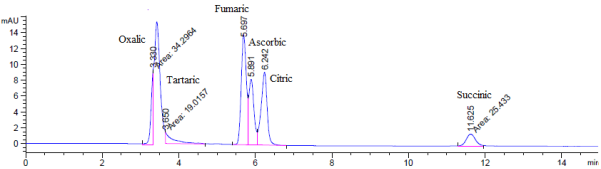
Figure 1. Chromatogram of Standard 1.
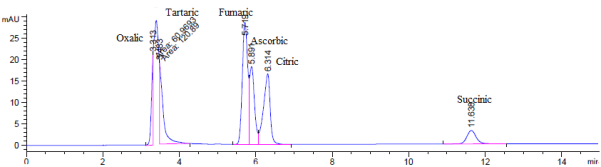
Figure 2. Chromatogram of Standard 2.
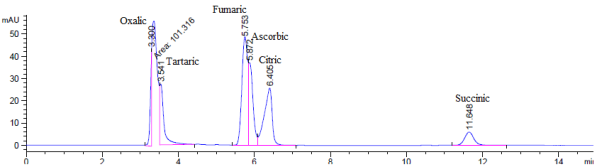
Figure 3. Chromatogram of Standard 3.
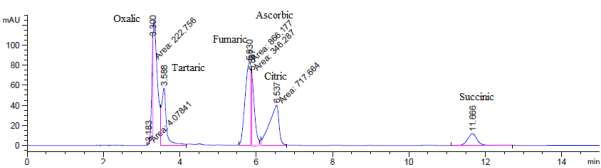
Figure 4. Chromatogram of Standard 4.
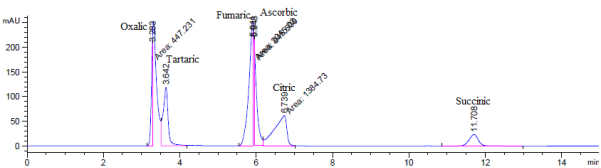
Figure 5. Chromatogram of Standard 5.

Figure 6. Chromatogram of sample A orange juice.

Figure 7. Chromatogram of sample B orange juice.

Figure 8. Chromatogram of sample C orange juice.



 Share This Article
 Twitter
 Linked In
 Facebook
 Copy
Copy Download